Welcome to Birmingham Bird Control: Prevention and Removal of Unwanted Birds
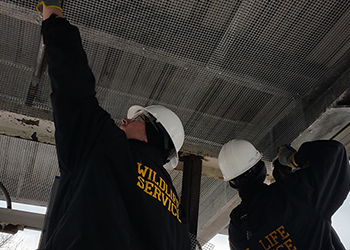
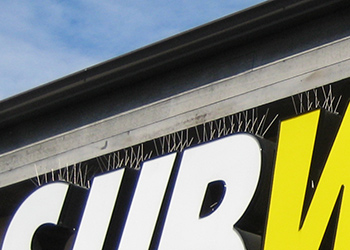
Our company specializes in resolving problems caused by birds in Birmingham, Alabama, both residential and commerical. We handle bird species such as pigeons, starlings, grackles, sparros, and even Canada Geese and woodpeckers. We generally don't kill birds - we prevent them from causing problems. Most commonly, this means that we install barriers that prevent them access to your building or property, or anti-roosting devices that prevent them from landing, nesting, or roosting on your home, store, building, or anywhere. We use netting, needle strips, shock track, and more. We do offer trapping in some cases, and removal of birds from warehouses, grocery stores, or other commerical or industrial buildings by netting or sometimes pellet shooting. We have a wide variety of tools and methods for solving every manner of bird problem. Call us at 205-383-2321 to discuss your bird problem today.Our Work
Full Range of Bird Control Services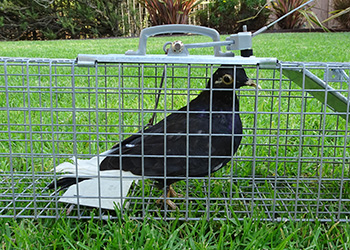
More About Us Birmingham Bird Control:
We have been keeping your commercial and residential properties safe from birds for more than 10 years and counting. We offer a trustworthy, efficient, fast, and effective bird removal program. Allow our specialists to identify your source of the problem and provide the right solutions for your concerns. With us, you will save time and money since we can do it right the first time. What's more, all materials and services come with a warranty and guarantee. If our deterrents failed to fulfill their work during a specified time, we will return and re-do or replace the installations without any extra cost. Keeping you healthy and away from any hazards related to birds are our mission. We want you to realize that protecting your family against the property damage and health risks of the birds should not be expensive. If you choose a company that will work towards a common goal, you will definitely be satisfied with the result. No other company can provide you with the same quality and level of service. Our service is the result of continuous training, discovery, and refinement in pursuit of perfection. Experience the benefits that we offer to our customers. Reach out to us and let us show you how we can make a difference.The Truth About Pigeons
Pigeons ... They're often considered a pest animal, although all pigeons were once domesticated animals and are only feral pests as a direct result of human activity. It's an activity that turned around to bite us in the butts, especially when you look at the extremes of damage and disease that the bird can bring along with it.
If you have a pigeon problem on your property, you'll need to deal with medical conditions such as cryptococcosis, salmonella, histoplasmosis, toxoplasmosis, and more. You will also need to bear in mind the impact that other pests and parasites can have, brought to your property by the pigeons — ticks, mites, lice, and fleas. All of these nasty bugs can be found not just in the bodies of the birds themselves, but also in nests, young pigeon squabs, bird feces, and even materials that they have come into contact with. Their feces is considered to be one of the most dangerous parts of the infestation, with certain disease spores being sent airborne once they have dried out and turned into a dust-like consistency.
Not only will pigeon feces spread disease to people and other animals, including your pampered pooch and feline friends; it can also cause damage to the materials it comes into contact with. It has a high acidity level, which is quite odd, but it also makes it quite dangerous. The feces material will burn through other materials if there is enough of it, or if it is left where it is for long enough. Unfortunately, the feces material is not simply cleaned up by sweeping it away once it has all dried up. This airborne material — like dust — could contain histoplasmosis spores, as well as other bacteria, bugs, and organisms, that could then be inhaled. If you've ever watched a pigeon control professional working, you'll notice that they always face a breathing mask. (Or they should do.) This is to ensure their own safety.
We actually personally recommend hiring a professional for pigeon control, although we are meant to say that ... being the professionals in question here. When we tell you that this job is a big one, though, we're not kidding. Between the difficulties most people face when trying to get rid of the pigeons from their property in the first place (repellents and deterrents very rarely work), there's also repairing the damage (such as entrance points that allowed them to physically enter your attic/building), cleaning up the waste, and then making sure that the pigeons have nothing left to attract them there — food, etc. With great memories, pigeons WON'T forget about that roosting or nesting ground, and they may even return to it many years in the future. If your building hasn't been sealed and appropriately maintained, those birds are free to try and get back in again, and they'll probably manage it, too.
We have the most experience in Birmingham at understanding the nuisance birds of Alabama. Our 7 years of experience in the field ensures excellent results.
We pride ourselves on the quality of our bird control work. Our work is professional grade and long lasting, usually for the life of the building.
We are fully Alabama licensed. We carry the correct safety equipment, and operate in a safe and professional manner to keep your building and people safe.
Call us at 205-383-2321 to discuss your bird problem and our process. We are always responsive by phone. We can usually schedule next-day appointments, and provide written estimates for all our bird work.
Thank you Birmingham Bird Control for keeping the pigeons off of my storefront. My sidewalks are clean now!
These guys were the only ones who could get a sparrow out of my clothing store. Thank you!
Your goose abatement program has kept my golf course dropping-free. I recommend Birmingham Bird Control.